Humanity is actively working towards a mission to Mars. When astronauts like Bernard Harris leave Earth, they accept risk as part of the mission. But a journey to Mars would push that risk into entirely new territory—where help is unreachable, uncertainty is unavoidable, and coming home may not be an option. This episode explores how space agencies, astronauts, and all of us need to grapple with how much risk is ethically acceptable for individuals to take on in pursuit of societal benefit, and who gets to decide.
- Johns Hopkins Berman Institute of Bioethics
- Research & Outreach
- The Dracopoulos-Bloomberg iDeas Lab
- Projects
- playing god? A bioethics podcast
- playing god? Season Two
- Episode 2: To Infinity and Beyond—At What Cost?
Episode 2: To Infinity and Beyond—At What Cost?


Featuring


Episode Transcript
Bernard Harris
I believe that as human beings we’re always explorers. We’re always looking over the next horizon. Well, when people find out then that I’m an astronaut, you know, and a pilot, they say, “Boy, you, you must really like risk. You must be comfortable with risk.” And I said, I describe myself as a person who takes calculated risks. I’m not a bungee jumper. I don’t like to jump out of, you know, a perfectly good aircraft unless I absolutely have to. You know, so there are people who are like that. I’m not one of those folks.
Lauren Arora Hutchinson
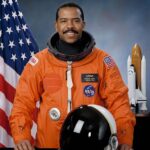
This is Bernard Anthony Harris Jr. He was the first African American to complete a space walk.
Bernard Harris
Visualize yourself in this suit, this bulky suit in a small chamber. You open up the hatch. Of course, your heart rate goes up a little bit, but this is something that you’re trained for all your life. And, the hatch was facing toward the earth, so immediately I felt like I was falling, and the only way I can describe it is if you’ve ever been in the country and have walked up to a well and looked over in the well and saw how deep, that’s what it felt like. The other thing is that not only was the earth down below me in the sense that I was falling, there was this great sense of movement. We’re going around the earth at 17,500 miles an hour. That’s pretty darn fast, around the entire earth in 90 minutes.
Lauren Arora Hutchinson
I’m Lauren Arora Hutchinson. I am the director of the iDeas Lab at the Johns Hopkins Berman Institute of Bioethics. I’ve spent years working on stories where medicine and science show up in people’s everyday lives. I can’t imagine going 17,000 miles per hour. I can’t imagine going into space, but for folks like Bernard, it’s a risk they’re willing to take. But I do have a son who’d love to go, and I don’t know… As a mother, I can’t imagine him going into space, and strangely, this little observation in my life seems to speak to a larger societal question we’re about to confront. As we prepare to send people not just to the moon, but to Mars and beyond, what is the level of risk we’re willing to accept for our metaphorical sons and daughters? Or to put it more simply, in something as risky as space travel, who gets to decide what’s too risky? This is playing god?
Bernard Harris
When I was about six-seven years old, my parents divorced. My mother had a college degree, so she had options. The option that she executed was to get her family out of this inner city environment in Houston, Texas, to the Navajo Nation, but the whole point is that I was taken out of that constrictive environment to this environment of Grand Canyons and painted deserts and infinite possibilities. And, one of those possibilities really was symbolized by me as a kid watching the night skies, and I can’t tell you how beautiful the night skies are in that neck of the room, there’s no light pollution that prevents it. You don’t need a telescope and all that. So, I was inspired by those guys, and at the same time watching the space program develop before my eyes, and so in 1969 when Neil and Buzz landed on the moon and said those wonderful words, I was, you know, just blown away by the possibility that I could follow in their footsteps, and it was, it was incredible. I came into NASA about a year or so after the Challenger accident, and I remember what my family and friends and media would would talk about that, and you’re joining the astronaut corps, and you know, didn’t you see just what happened? And… and I simply believe this, that I would rather live your or die doing something that I love doing and accomplishing a dream than to live in fear, so that’s that’s my, my way of thinking about. I think the spacewalk is symbolic of life in a sense. So you spend your entire life chasing a dream, getting all the tools and the skills necessary to accomplish that dream, the last thing to make that dream happen is that step, right? It’s that step of faith that everything that you have done in the past is going to allow you to successfully take that first step, that gigantic step. That step for not only mankind, but for you as an individual.
JD Polk
I’m Dr. J.D. Polk. I’m the Chief Health and Medical Officer of NASA.
Lauren Arora Hutchinson
JD Polk is responsible for the health and safety of astronauts as they prepare for and experience the harsh environments of space.
JD Polk
You know, certainly, most astronauts want to fly. So that’s that’s probably one of the push pulls we have as flight surgeons at NASA is you work for two masters. You’re serving the patient, but you’re also serving the agency and looking out for the risks of both, and sometimes they are incongruent, where someone may be willing to take that risk, but the agency is not, or vice versa. The agency itself, I have seen, is not afraid of risk, but they go about risk in a very strategic, methodical, and objective way.
Lauren Arora Hutchinson
But as we start traveling further and further from Earth, this gets more and more complicated…
JD Polk
You know, we’ve, we’ve been a little, I guess sheltered in our space flight, and that we have gotten to the moon, but we’ve always been within three days of the Earth. Apollo 13 is a great example. Something went wrong with the spacecraft, we were able to get the astronauts back through a lot of heroics from Mission Control and the astronauts themselves, and if something went wrong on the International Space Station, we could get the astronauts back very quickly, but you know when you, when you go to another planet, Mars and Earth don’t line up again for another 18 or so months, and so you take on a different level of risk.
Lauren Arora Hutchinson
And not only is where we’re going changing, but who is going.
Bernard Harris
We’re going to have different types of folks who are doing different things, who are quote unquote astronauts, and they will be doing it for different reasons and different objectives than what we have now. So, some of those will be for the good of all mankind, some of those will be the good for the company objective, some of those will be just experiencing microgravity, and what’s that light, and space, and space exploration is that next horizon for humans on this earth. We’re going to be living in orbital platforms around the earth. We’re going to be living on the moon, and we’re going to go to Mars.
Lauren Arora Hutchinson
And for all these different reasons, to go into space is the same level of risk acceptable for everyone?
Bernard Harris
It’s a, it’s-it’s a complicated question that has a complicated answer to it.
JD Polk
But there’s always the risk of the unknown, right? I think probably the most difficult problems we have are the unknown unknowns, when something is operating outside the specs that it was designed to do, and you wonder, okay, where’s how much margin do I have here. We think we have comfort, and we think we have data, but do we have enough?
Jeffrey Kahn
NASA is an exploration agency, and there’s nothing else like that in the federal government.
Lauren Arora Hutchinson
That’s Professor Jeffrey Kahn, our resident bioethics expert, who also has served as advisor to NASA on the ethics of human space flight.
Jeffrey Kahn
They have this funny combination of go and go beyond and go safely, but also you know they’re doing it with the money of the taxpayers of this country, so they have to do it in a way that’s responsible and responsive to the expectations of society.
Bernard Harris
Those early explorers set the stage for what we’re doing now. I’m excited about what’s happening in space. We’re going to have different types of astronauts doing different things. We’re going to have those professional astronauts going to be the ones that are going to pave the way to the moon and pave the way to Mars. Those are going to be followed by astronauts that will be living, not just explorers, but be living and working in space, and so this whole ecosystem that is going to develop in low Earth orbit, moon and Mars, is going to result in this tremendous advancement in knowledge, this tremendous intellectual capacity as human beings, as we explore the galaxy. Will also provide some psychological and sociological challenges for us as we embark on this new frontier, but you know we’re going to do it. There’s there is no doubt in my mind that this is where we’re headed. This new era, this new industrial revolution that’s going to occur is going to be on the backs of men and women who seek to explore the unknown.
Jeffrey Kahn
NASA is a US government agency that’s spending our money as taxpayers to send humans out into space, and there’s a responsibility in their doing that when the goal of it is to help advance societal goals that they need to do it in a way that’s not just, you know, engineered in the best possible way, but that respects ethics principles in terms of the health and safety of the astronauts as well. So they see it as a responsibility really on the part of the agency to take care of the people that they put in harm’s way for benefits that are accruing to society as a whole.
Lauren Arora Hutchinson
As we go further and deeper into space on longer exploration missions, we have to start thinking differently about risk.
Bernard Harris
When you’re in low Earth orbit, you know it’s just a millisecond or so latency versus the 20 minutes from ours, and so if there are any issues, particularly medical problems, we can immediately call back down to Mission Control, they can connect us to a specialist that can help us resolve our problem, and it’s almost done real time. In addition, if there are any serious illnesses, then we can immediately deorbit and come back within hours, which is something we can’t do if we go to Mars, or even the moon, for that matter.
JD Polk
If you think about somebody on the space station today, if they scratch their cornea and it doesn’t heal, I’m not going to make an astronaut sacrifice their left eye for the space program, and we would bring them down. We’d have them in a hospital with ophthalmologists to getting care, but when you go to Mars and the planets don’t line up again for another 18 months, if you scratch your cornea while you’re on the second day of arrival on Mars, you’re not turning around and coming back. It risks the crew, and you’ve now put the other people at risk. It risks the mission. All of those things change to where now you know the life and limb is subordinate to the mission, instead of the other way around. And so that’s that’s one of the probably the biggest ethical paradigm shifts in exploration missions versus low earth orbit and near earth missions like the moon.
Jeffrey Kahn
It just won’t be possible to bring people back or to send a crew to help in time, and that’s a different ethics calculation, as well as a different kind of just understanding of mission. And so, that’s just part of the conversation that the agency is is having, and first and foremost, that the crew understands that that’s what they’re accepting as a function of going on these missions, and second that the American people appreciate that that’s the level of commitment and risk that the crew is accepting, that NASA is asking the crew to accept, and the American people have to be willing to understand that there will be untoward events, and there could be fatalities, and people lost on missions, and that has to be an acceptable thing for us as a, as a people.
Bernard Harris
So, there does need to be a level of autonomy for the crews, and one of the things that I think is important, and that is that we will go from this ability to provide immediate services and feedback and advice and counsel to this: how do we support the crew to make their own decisions while they’re there?
Jeffrey Kahn
So, the crews will have to make decisions in ways that are not as supported by the many, many people on the ground that otherwise support every mission, and there’s some talk about trying to aid that decision making with artificial intelligence, but at the end of the day, it will be crews deciding about what should happen in real time in a much more kind of isolated, you’re on your own kind of way, which is a different kind of a different ethics commitment on the part of the crew and the members of the crew and the part of the agency to accept that. It’s like you know you can do certain things when you’re tethered and you feel much safer about it. It’s a different thing if you’re jetting around in space without a tether attached to the space station, it feels kind of like that level of difference. We’re kind of on our own. We’ll have to manage whatever comes.
JD Polk
It’s not just a vested interest to make sure that the nation succeeds, or that NASA succeeds, but it’s personal. You want to make sure Butch and Sonny come home safely. I think that part, the humanizing of that risk, is something that’s important, and I think it’s something that the agency does fairly well.
Lauren Arora Hutchinson
We asked astronaut Bernard Harris if he would sign up for a mission to Mars.
Bernard Harris
I, you know, I would. I would certainly like that opportunity at some point in time. I joke and say to folks that I would jump on immediately if we were going to the moon, it’s close since I can go and come back, but if going to Mars, you know, it is a three year trip, at least a three year trip. So, do I want to do that at this age, or would I wait till later? And so my joke is that when I turn 80, I’ll go to Mars. I’ll be one of those octogenarians who will volunteer to go to Mars, because I won’t care whether I come back or not, and I advance, of course, human exploration further.
Lauren Arora Hutchinson
Advancing human exploration further is a drive that shaped human history, and one that has always come with risk. For adventurers like Bernard, and those who will follow him, the rewards of space travel are being at the forefront of new discoveries are worth the risk, but for NASA, astronauts and all of us left back down on Earth, how do we grapple with the risks of sending someone into space without the option of help, if things go wrong? Who gets to make that decision? What new discoveries are worth risking human lives? Would you be scared of going into space?
Child
I don’t know.
Lauren Arora Hutchinson
Would you want to go as far as Mars?
Child
Yeah.
Lauren Arora Hutchinson
Why?
Child
Because I wanna see above space ’cause it, it could be cool.
Lauren Arora Hutchinson
Yeah, does it feel. do you think it would feel risky?
Child
Um, I think so.
Lauren Arora Hutchinson
But you want to take that risk?
Child
Yeah.
Lauren Arora Hutchinson
Why?
Child
Because I would see if I could do it.
Lauren Arora Hutchinson
Yeah?
Child
Yeah.
Lauren Arora Hutchinson
Join us next week on a special two-part episode of playing god?
Guests
If you had cancer that ran in the family, would you have a child? Put yourself in a position like that, what would you do?
Lauren Arora Hutchinson
Where we meet a couple who became accidental pioneers of genetic medicine…
Guests
And I said, “Oh my God, you came into this world like loud, you just made sure that you are here,” like…
Lauren Arora Hutchinson
Many thanks to our guests in this episode. To Bernard Harris for sharing his story with us, and to Jeffrey Kahn and JD Polk. playing god? is a production of the Dracopoulos-Bloomberg iDeas Lab at the Johns Hopkins Berman Institute of Bioethics, made in association with Sea Salt and Mango Productions. This episode was produced by Lauren Arora Hutchinson and Aaron Henkin, with help from Lyric Bowditch, Brian Ricker, Amelia Hood, and Mrigaanka Sharma. Our executive editor is Tony Phillips. Music and sound design by Alexander Overington. iDeas Lab producer, Lyric Bowditch. Researcher, Brian Ricker. Story editor, Simon Adler. Show art, Barry Pousman and Shawn Carney. Our production coordinators are Leah Lord and Susan Snead. Our executive producers are Jeffrey Kahn and Anna Mastroianni. I’m Lauren Arora Hutchinson, host and managing editor. Come back next week for more playing god?
The Johns Hopkins University Sesquicentennial is proud to support this podcast. JHU celebrates 150 years of pioneering education and research—advancing knowledge to meet the challenges of every generation. Learn more at 150.jhu.edu.
Continue the Conversation
We want to hear your thoughts about this episode. Please share them using the form below and your comments could be posted on this page and made accessible to other listeners.