hyper_object
555 Pennsylvania Ave NW
Washington, DC 20001
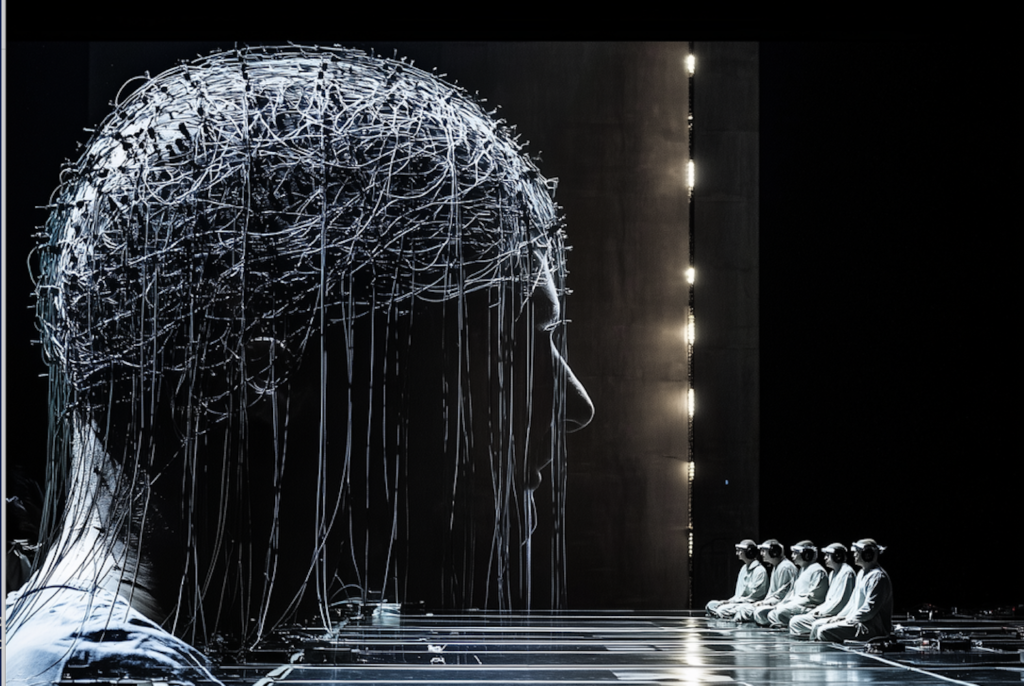
hyper_object, a new immersive neuro-theater performance created, written, and directed by Professor Graham Sack in collaboration with an interdisciplinary team of artists, scholars, and engineers from across Johns Hopkins University, will premiere June 4, 2026, at the Hopkins Bloomberg Center in Washington, D.C. Blending live theater, artificial intelligence, wearable neurotechnology, and interactive media, hyper_object tells the story of a mysterious planet that can perceive the thoughts of humankind. The production asks profound questions about the relationship between human intelligence, artificial intelligence, and planetary intelligence at the beginning of the 21st century.
Tickets are free, but advance registration is required: https://hyperobject.thundertix.com/
The June 4 premiere marks the culmination of an intensive interdisciplinary development process funded by the JHU Nexus Awards, which specifically support projects that leverage Johns Hopkins’ cross-disciplinary strengths while engaging new audiences at the Hopkins Bloomberg Center in Washington, D.C.
The performance explores how brain-computer interface technology and AI can reshape the future of live performance, immersive media, and interactive storytelling. Actors and a select group of audience members wear electroencephalogram (EEG) headsets that measure patterns of brain activity. These real-time signals control a responsive audiovisual environment, including multi-surface video projections, generative music and sound design, and a responsive dialogue system. At the center of the work is the “hyper_object”: a virtual character representing a sentient planet that responds to human brainwaves. As performers and spectators generate live neural data, the performance environment shifts around them.
“At the heart of hyper_object is a question that feels increasingly urgent: what happens to the status of human intelligence when artificial intelligence seems to know us better than we know ourselves, while planetary systems and the climate catastrophe reveal the limits of our ability to predict or control the world around us?” said Sack, the project’s creator and director and a faculty member cross-appointed at the Johns Hopkins Berman Institute of Bioethics and in Immersive Storytelling and Emerging Technology. “By using live brainwave data to shape sound, image, and performance in real time, the piece turns that question into a direct theatrical experience — a feedback loop among actors, audience, technology, and environment.”
Set aboard an international space station orbiting a mysterious exoplanet, hyper_object follows a crew of scientists studying an intelligence beyond the limits of human understanding. As the planet begins to evoke visions, memories, and unconscious fears, the crew must confront the possibility that the entity they are studying may understand them more deeply than they understand themselves. Through both its story and its form, the production raises urgent questions about AI, neurotechnology, and the future of human identity. What happens when machines can interpret signals we may not fully understand? How do biometric systems change the boundary between performer and spectator, mind and machine, individual and collective experience?
“The Nexus Awards challenge faculty from across Johns Hopkins to explore new kinds of collaboration,” said Debra Mathews, principal investigator for the project and a professor at the Berman Institute of Bioethics. “With this production, we have brought together engineers, artists, humanities scholars, clinicians, and bioethicists to investigate how emerging technologies can be integrated into live performance to explore deeply human questions in novel ways.”
The initiative underscores the Berman Institute’s commitment to making complex bioethics questions accessible through innovative, public-facing outputs . Sack first initiated hyper_object as a postdoctoral Fellow at the Institute’s Dracopoulos-Bloomberg iDeas Lab, a creative studio and intellectual incubator for telling world class stories at the intersection of science, medicine, and ethics.
“This project exemplifies how creative practice can deepen public engagement with the ethical dimensions of emerging technologies,” said Lauren Arora Hutchinson, director of the iDeas Lab. “By merging art, science, and ethics, hyper_object creates a space where audiences can experience — not just analyze — the implications of AI, neurotechnology, and responsive systems.”
The premiere is expected to draw audiences from across the arts, sciences, policy, technology, and academic communities, reflecting the project’s ambition to bridge disciplines and spark public dialogue about the future of intelligence in many forms.